Showing posts with label sun printing. Show all posts

Tuesday, August 31, 2021

Quilt Camp Day 6

We were saying to each other today that it doesn't seem like we get as much done these days as we once did!  What's up with that?

If our math is right, this is the tenth time we have had quilt camp.  The number of years is higher  because we had a few years when we couldn't get together.  Probably somewhere around 14 years we have come to the garage here at Merrymount on the shores of Lake Winnipesaukee to stir our creative juices and work on our business selling Thermofax screens through Etsy and promoting them on social media.

Today Elizabeth rinsed out the excess dye from this lovely vine flower Thermofax screen done with Color Magnet and Coral MX dye.


And her pole dyed piece.  Not sure why this year the white lines from the string isn't as prominent.  Perhaps oversoaked, not wound and scrunched tightly enough or too few layers on the pole.  It is still ok, just a faint glimpse of texture.


You saw a sneak peek at Molly's new shirt the other day on the blog but not the vine flower around the hemline.  The t-shirt was first screened with the design using Color Magnet, left to dry and then ice dyed.


Elizabeth also screened this hand drawn ginkgo leaf, onto a long piece of previously dyed fabric, using a blue acrylic fabric paint which sparkles just the slightest amount.


And this green piece was screened with a new screen made from a photo of birch bark.


Sue has some pieces that didn't get included in yesterday's post.  One is this piece of rusted fabric that was folded and dipped in the indigo pot.

In an effort to make some ugly fabrics more palatable, they were also dipped in the indigo pot.  The left photo is "before", the right photo is "after".  A small step in the right direction.  Looks like another dip in the indigo pot is called for!

We didn't have much sun today, but there was enough to put out a quick sun print with some stencils.

The best ending to the day was that Bob drove us to Wolfeboro and treated us to an ice cream at Bailey's Bubble.


Friday, August 16, 2019

Mini "Quilt Camp"

If you've followed our blog for any length of time, you know that Elizabeth and Sue usually get together in New Hampshire in the summer for "quilt camp".  This is not an actual "camp", just us having play time at Elizabeth's summer house on Lake Winnipesaukee. Unfortunately circumstances haven't allowed for us to have quilt camp this summer, but since Elizabeth is back in VA for a few weeks for a medical procedure, we managed to get together for a play day.  Both of us have been experimenting with cyanotype printing (also known as blueprints) - this is a form of sun printing in which specially treated fabric turns blue when exposed to the sun.  Natural objects are most often used as resists to block the UV rays and create the print. If you follow us on Facebook or Instagram, you'll see lots of pictures like this one.
Another product that is supposed to work similarly to cyanotype is called Solar Fast by Jacquard.  There are various colors that are painted onto the fabric, and as with cyanotype, something that blocks the UV rays creates the print.  Sue had some leftover product and decided to see if it would still work.  In addition to natural objects, you can use transparencies of images to create prints, so she decided to try transparencies of some of our screen printing images.
Above are the Jacquard Solar Fast film product and the printed images Sue used.
This is the "before" photo - the 2 pieces that look yellow are painted with teal colored solar fast, and the pinkish one is painted with violet.  The black images are the transparencies.
This is what they looked like after exposure to the sun.  They were outside for about 45 minutes; the recommended time was 10-20 minutes. However the results were less than inspiring.
Not sure if the product was too old, exposure wasn't long enough, sun not bright enough?  Lots of variables.  Perhaps buying fresh product would help answer the question.  At any rate, we did try transparencies with cyanotype fabric and that did work so the transparency was not the problem.
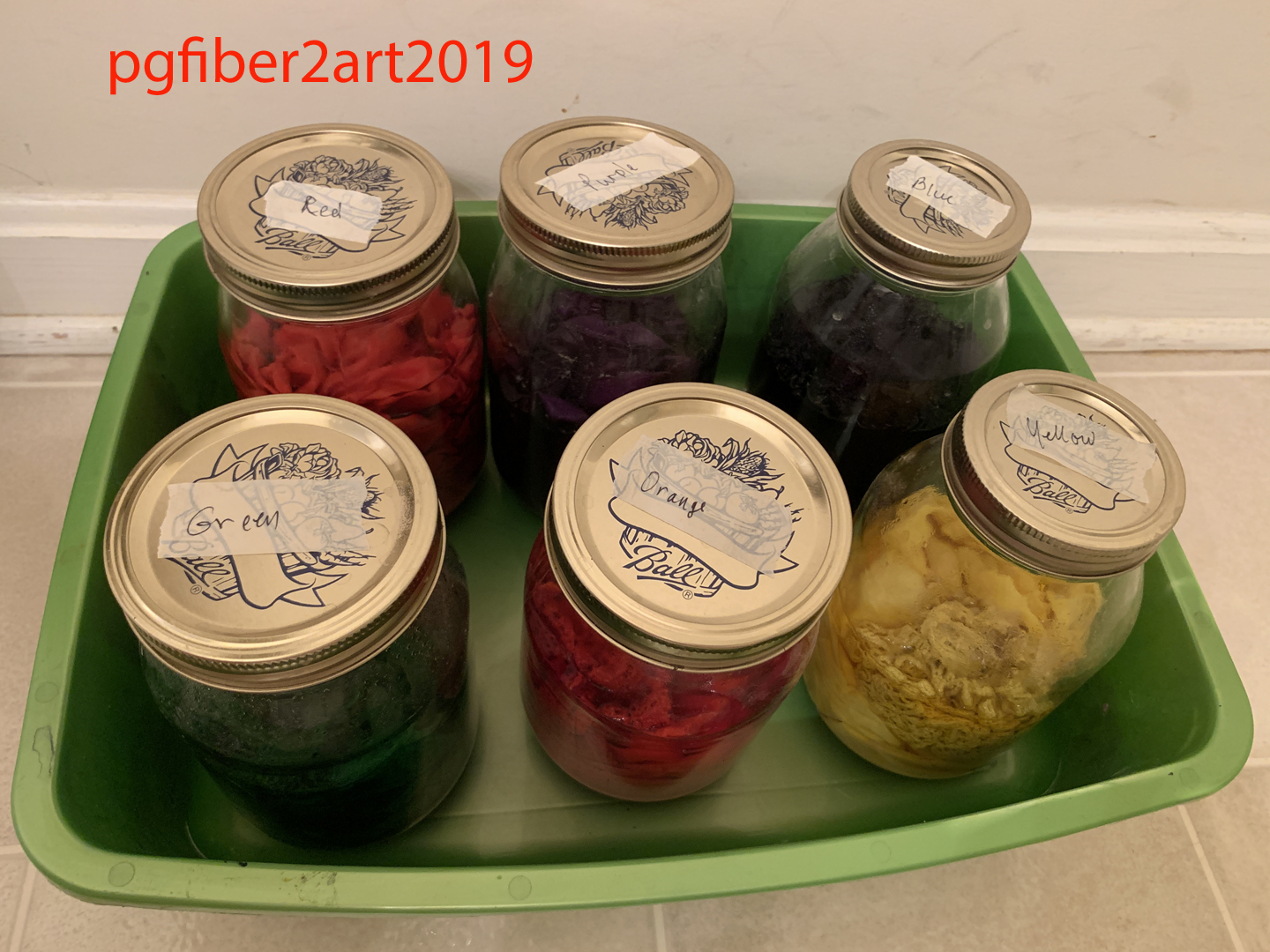
Sue wanted to do some low water immersion dyeing so set up these 6 jars with the primary and secondary colors.  More to come on those results.
Back to cyanotype printing.  These are the same transparencies from the solar fast on cyanotype pre-treated fabric.  The top is Jacquard fabric and the bottom is from Blueprints.  This photo was taken after exposure, before rinsing.  The image is a little hard to see, especially the bottom so you might have to enlarge. After rinsing, the results are quite different.
This is one of our crackle screen images, and was done with a dry process. (We have been experimenting with wet cyanotype too.) Much better results than the solar fast.
Surprise, this piece turned out to be green!  It was hard to tell what color it was before exposure.
This treble clef was a card stock cut out that did a good job of blocking the UV rays.
Between the fabric and ginkgo leaves was a small piece of cheesecloth.  Since the threads are so fine, it didn't make a real noticeable print except where the edges were a little thicker.  Oh well, it's a matter of figuring out what works and what doesn't.
Finally, an attempt at sun printing with paint, trying Artistic Artifacts paints to see if they would work.  The results were not as good as we hoped, but worth another try. The fabric should have been wet before applying the paint, so perhaps that would have made a difference.
The print is kind of vague, so we decided enhancing the edges would "fix" it.
A gold sharpie was used to outline the edges. 

Stay tuned for more on the dyed fabrics.


Monday, August 27, 2018

Day 12 - Wrapping Up Quilt Camp

Unfortunately, all good things come to an end and it's time to wrap up quilt camp for another year.  Sue will be leaving Monday so it will be up to Elizabeth to carry on as she remains in NH through mid-October.  Here are some photos that kind of sum up what we have accomplished in the last 2 weeks.
On the left is Elizabeth's set of yardage she dyed.  On the right are pieces that were first printed with color magnet and then dyed.  The lighter pieces are some that were in dye a few days old that was pretty well spent.
Sue's dyed and discharged pieces are on the left, her mostly solids on the right.
Above are some color magnet pieces, and below, some that were printed with thickened dye.
Sue dyed a T-shirt with black cherry dye; it's taken a few days to get through the wash out process.
The two pieces below are failed sun prints that were salvaged by adding other types of printing - wooden block prints and thermofax screens.  You can see a bit of the sun prints in the background.
The new technique we tried this year was wet cyan.  Cyanotype is a form of sun printing, where the fabric is pre-treated with chemicals and then with exposure to sun, a blueprint of the resist item appears.  Traditional cyanotype is done with dry fabric.  In wet cyan, the fabric is spritzed with a soda ash solution and water before being exposed to the sun and produces more interesting backgrounds and color variation.  After some initial test pieces, the second round produced better results.
Since it was our last day, we took a trip into Wolfeboro for a little shopping and of course some ice cream.
And finally, it is time to clean up the dye pots and load the car.  Hope you enjoyed following along on our quilt camp adventures!

Monday, August 20, 2018

Day 5 - Studio Play

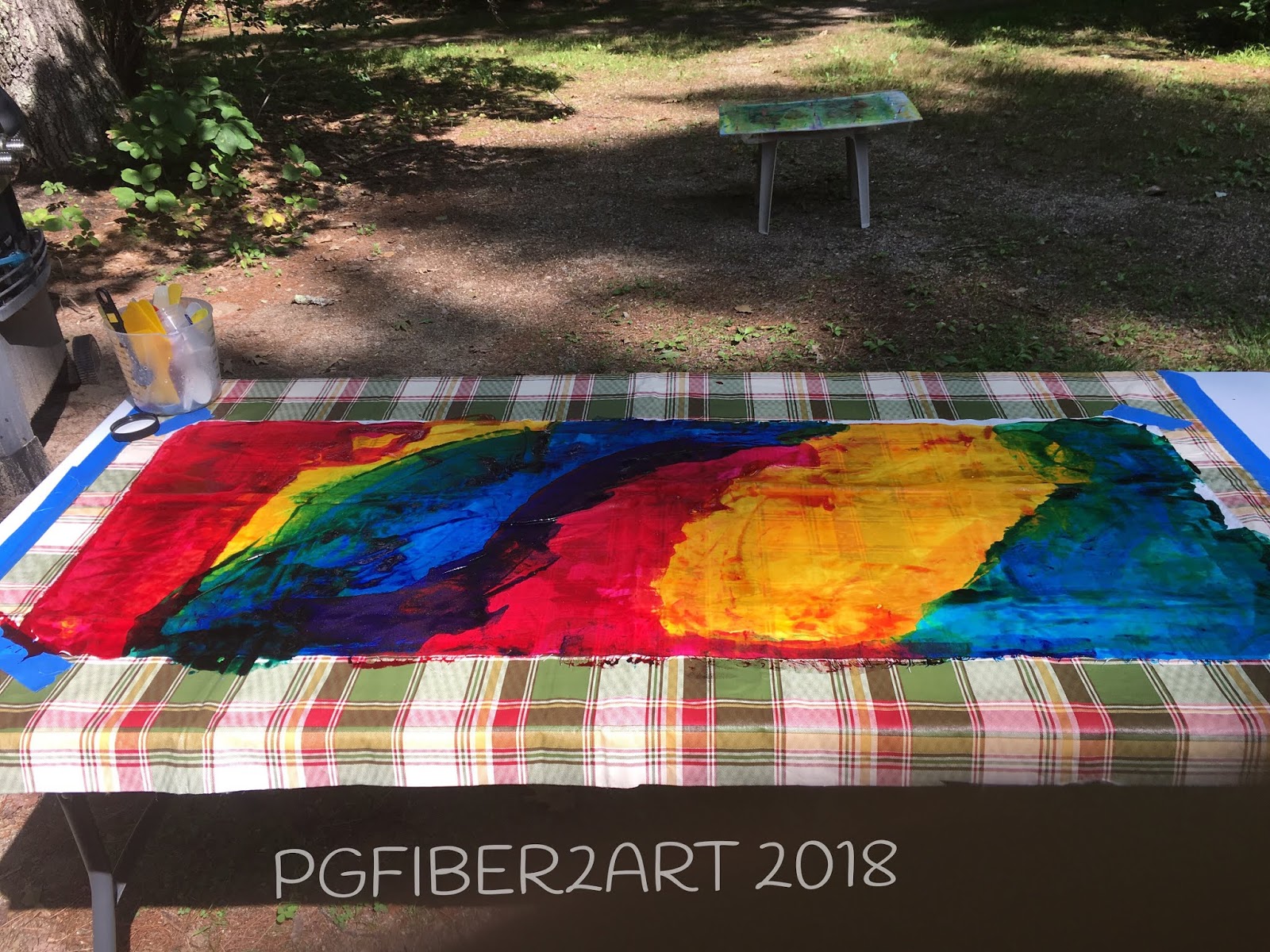
Sunday was a day to rinse and launder a bunch of dyed fabric, but it was also "play in the studio" day.  We each went in several directions.  We mixed up 3 colors of thickened dye.  Elizabeth painted this piece with red, yellow and blue, allowing the colors to overlap and mix.  It still needs to be rinsed and washed to get out the excess dye.
She also spent some time adding texture to fabric using a gelli plate and various objects for the texture. 
One was bubble wrap.
She also used textured pieces of foam.

You can buy commercial gelli plates but Elizabeth opted to make her own with gelatin.
Here's a wavy texture printed on a light purple fabric.
Sue printed a few pieces of fabric with color magnet, which is a dye attractant.  When the fabric is dyed more dye is drawn to the printed parts so you end up with a two-tone fabric.
She also painted backgrounds on some small pieces.  This is the first layer of several.
And since the sun was shining, it was a good day for sun printing.  These are the two pieces she printed with natural objects.
Come back tomorrow to see what else we are doing!

Monday, August 24, 2015

Amond Milk Experiment

After reading the article “Sunshine and Shadow” about sunprinting with soy milk  in the August/September issue of Quilting Arts Magazine and having a carton of almond milk left by company, Elizabeth decided on using it in an experiment. We have sun printed before using several different types of paint but never with dye.  The advantage of dye should be the ‘hand’ or the feel of the fabric after application.  Since paint sits on the surface of fabric, it often leaves it stiff while dye bonds to the fiber of fabric and doesn’t significantly change the feel of the material.  It would be nice to be able to sun print with dye since it wouldn’t affect the drape of the fabric.  Elizabeth was not inclined to buy all the ingredients to make homemade soymilk and then spend the time squashing soy beans.  So, she set off to experiment with the leftover almond milk using the article as a guideline to see if it would work.

After soaking some PFD (prepared for dyeing) fabric in soda ash, she measured out half a cup of almond milk and put it in a container that would never again be used for food.
Add in half a teaspoon of dye powder (navy and fuschia were used in the two containers) and stir it together. Then quickly brush it on the soda ash soaked fabric using a foam brush. 
She placed a foam placemat on as the resist item along with a few leaves from a nearby blueberry bush and let it sit in direct sunlight until the fabric was dry.

After batching (sitting) for 24 hours, the items were rinsed and washed with Synthrapol soap to remove the excess dye.  As you can see, the results were less than stellar. 

Even though the resist dye didn’t prove worth the effort we still have a piece of dyed fabric, so all was not lost and if you never experiment you never learn anything new.  Here is the red piece after the final wash; this is the back side that picked up some texture from the plastic covering the foam core board.
So, what about homemade soy milk do you think makes the procion dye work as a solar resist? The article states that “soy milk binds the pigments to the fabric”.  It appears that the dye in this experiment bonded to the fabric just fine, it just didn’t give the solar resist we were seeking.  The answer probably lies somewhere in the field of chemistry but we are off to try new experiments…