Monday, May 22, 2023

Podcast Interview for Photo Memory Quilts

Tuesday, May 23 is Sue's interview with Lesley Riley about her quilt "Blessed Are the Piecemakers" which is published in Lesley's book Photo Memory Quilts. Lesley did a series of interviews with each of the contributing artists and is sharing them in a podcast on Spotify (free). New episodes air every Tuesday. The schedule is as follows:

1. May 2 - Margaret Abramshe 

2. May 9 - Whitney Dahlberg 

3. May 16 - Judy Gula 

4. May 23 - Susan Price

5. May 30 - Lorie McCown 

6. June 6 - Anne Sonner 

7. June 13 - Bobbi Baugh 

8. June 20 - Al Krueger 

9. June 27 - Susan Brubaker Knapp 

10. July 4 - Michelle Umlauf 

11. July 11 - Wen Redmond 

12. July 18 - Christine Vinh 

13. July 25 - Beverly Smith 

14. August 1 - Lindy Trenholm 

15. August 8 - Nanette Zeller

16. August 16 - Patty Kennedy Zafred 

17. August 22 - Gina Louthing Stanley

18. August 29 - Clare Murray Adams 

19. September 5 - Katherine Wilson  

20. September 12 - TBD

All episodes (and previous episodes) are at the same show link on the scheduled date. Hope you will tune in!

https://open.spotify.com/show/3MCefngOKmw0YmPjcIU8in

Monday, May 15, 2023

Cyanotype Postcards

Sue has been part of a postcard swap group for over 15 years, maybe 17 or 18? But we have finally decided to end our exchanges; the group has decreased in size over the years down to just 5.  Elizabeth joined us for the tail end.  There was not a particular theme for this round, just whatever each person wants to create. Sue decided to see how cyanotype prints of spring flowers would work.  

She gathered some blossoms from periwinkle, money plant, and azaleas and set up the components to expose them to the sun.  The cotton fabric was previously treated with the cyanotype chemicals.  The base is foam core board topped with the fabric, plant materials, and glass held in place with binder clips.  The arrangements were spritzed with water and vinegar before covering with the glass.  Different additions can vary the results of the print.


Then they were set outside in the sun for several hours.  The picture below show the boards after sun exposure.


Then the glass and plant materials are removed.  Sometimes the success of the print is evident, other times it takes extensive rinsing to get to the final print.  Rinsing is always required, but some pieces that Sue treated have more solution on them and take more rinsing.


Above is the periwinkle piece before and after rinsing.  You can see what a difference rinsing makes.  After several water changes, the piece soaked overnight to get to the final result. Sue used the periwinkle piece to create her postcards.  The printed fabric was cut into four 4 x 6 inch pieces and fused to the postcard base (a stiff interfacing like TimTex), then the purple stitching was added.  A backing of cardstock was fused to the other side and edges satin stitched.  


Above are the 4 postcards that were sent.  Sue was happy with the results to celebrate Spring and the final exchange of the group.

Sunday, May 7, 2023

Blessed Are the Piecemakers

Repost from June 10, 2020.  This quilt is included in Photo Memory Quilts featured last week and is currently touring with the Sacred Threads Quilts 2022 Travel Exhibit.

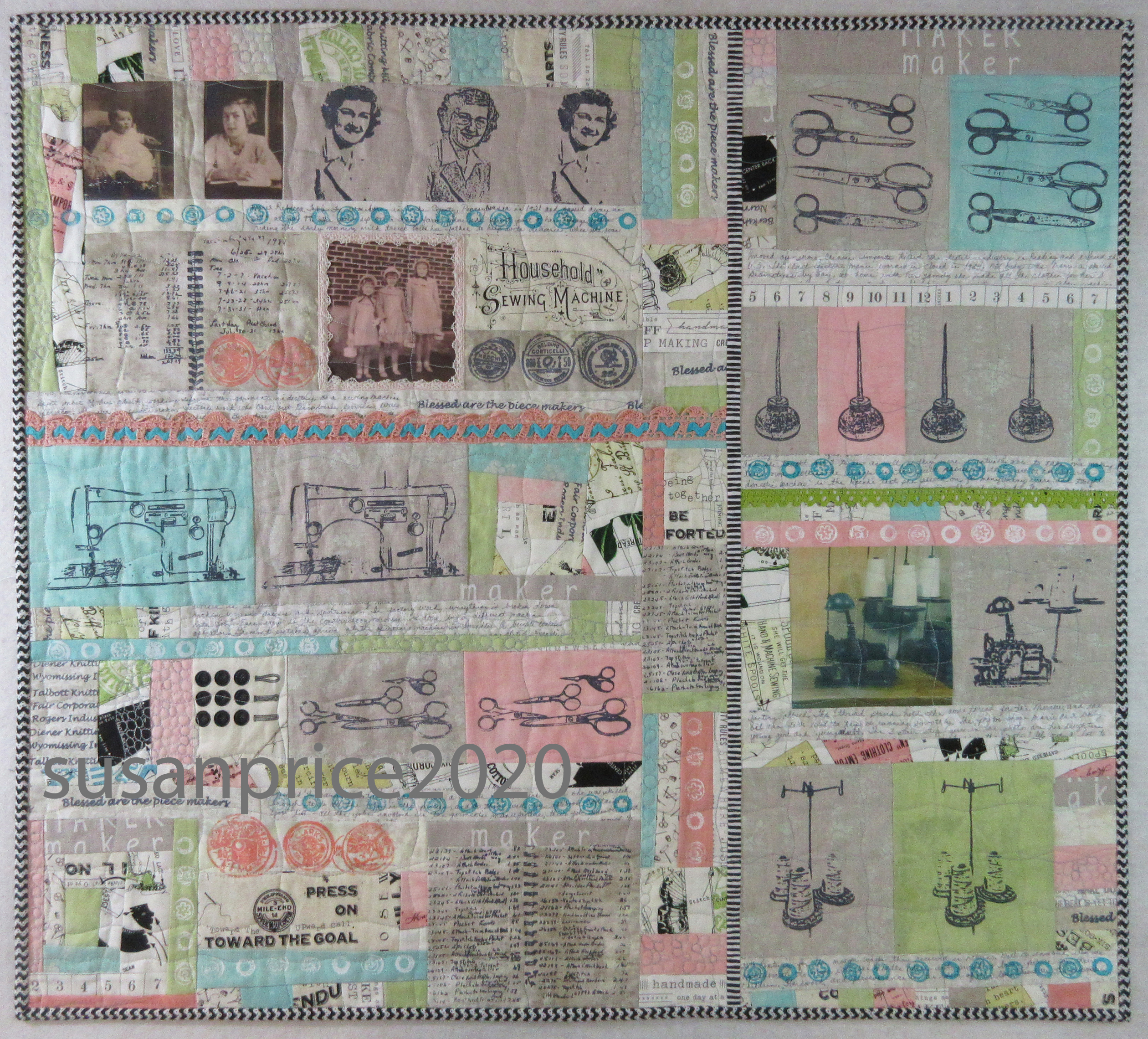
This quarantined spring has been a time to get ideas out of the head and onto fabric.  Sue's mother Marie passed away on May 29 of 2019, and ever since she has wanted to honor her memory with a quilt.  With outside activities cancelled and so much time at home, the opportunity presented itself to bring these ideas to life.  The quilt she made is a tribute to her mother as a maker and her working life spent as a sewing machine operator and sample maker in garment factories in Berks County, PA. In addition to sewing for a living, she sewed clothes for her 3 daughters, and taught them all to sew as well as other handcrafts.  This post is intended to give some of the backstory of the quilt as well as a look at the construction process.


The project started out by photographing and making Thermofax screens of Marie's tools of the trade, which included scissors, 2 sewing machines, an oil can and thread stand, and notebooks where she kept records from her factory work.  One of the sewing machines is the Necchi domestic machine she sewed on for many years, and taught her daughters to sew on, the other is a Merrow overlock machine from the last factory she worked in.
These images were printed on both natural and colored linen.  The color scheme came from a piece of fabric that is used in the piecing as well as on the back of the quilt.
There are also screen prints of Marie, and the quilt title "Blessed are the Piecemakers", chosen because factory work is piecework.  Sewers receive bundles of garment sections containing a dozen pieces, and pay is based on completed bundles.  Each segment of the construction process is a "job", and each job has a code number.  She worked in several different factories, from making men's cotton underwear to hosiery to women's clothing.  She was skilled enough at the various jobs and machines to become a sample maker.  The last factory she worked in closed in 1984 as more and more of the garment industry moved first to the south and then offshore in search of cheaper labor.    
Texture was added to some of the fabrics and linen prints by Geli plate printing with bubble wrap.  Paint is rolled on the Geli plate (in this case a circular one), then the bubble wrap is used to pick up paint and transfer it to the fabric.
After making various components, it was time to start playing with the layout.  This was one of the beginning ideas which you'll see changed a bit in the final product. The vertical fabric strip helped set the color scheme.
This version is closer to the finished piece, with eliminations and additions and moving things around, but still needing a spark.
These buttons and old spools of thread (from Marie's collection) were also made into screens. You can see them printed on the quilt in the picture above and below.
Above Sue was trying out a black & white stripe fabric to add the missing spark.  There are also some dyed laces added.  All of these required taking some seams apart to make the additions.
This is the finished quilt, with a black & white fabric also used for binding, and below is a close up.  
The quilting is simply wavy lines with bubbles in a few places so as not to detract from the graphic images.  Interspersed in the piecing are strips with the handwritten story of her life as a maker, meant to be visible but not necessarily readable.  

The piecemakers put a lot of effort into the American economy in the 20th century and made us proud to wear the "Made in America" label. They worked hard for their wages and were able to support their families and move into the middle class to provide a better future for their families.  Blessed are the Piecemakers.

Monday, May 1, 2023

Photo Memory Quilts

Lesley Riley, creator of Transfer Artist Paper, has just published her 10th book titled: Photo Memory Quilts - The Ultimate Guide to Contemporary Heirloom Quilts to Showcase Ancestry, History & Treasured Times.  It is available at Amazon and at C & T Publishing. If you have ever worked with photos on fabric, or just harbored a desire to do so, this is a book you need in your library!  Lesley shares invaluable information on sources for photos, particularly from the public domain, and dos and don'ts of copyright.  She also includes a crash course in photo editing and enhancement and answers many questions you might have on editing.  Most of her work is done on an iPhone and she has great recommendations for her favorite apps.  Other topics include photo printing (6 ways) and quilt design.

Sue was honored to be a contributor to this book; Lesley requested permission to include one of her quilts as an example of the principles of composition.  If you have the book, you'll find the full quilt picture on page 44 and an enlarged detail on page 46.  


The principles of design include contrast, focal point, balance, proportion & scale, repetition/rhythm, variety and harmony.  Do you see those things illustrated in this quilt?  It is titled Blessed Are the Piecemakers and is a tribute to Sue's mother who worked most of her life in the garment industry.  

The book also includes Lesley's methods for collage quilting, finishing and display, selected projects, and a gallery of photo memory quilts by an invited group of talented quilt artists.  Another feature of this book launch is a series of podcast interviews with each of the contributing artists.  The podcast is on Spotify and will launch on Tuesday, May 2 and continue every Tuesday thereafter.  The schedule is as follows:

1. May 2 - Margaret Abramshe 

2. May 9 - Whitney Dahlberg 

3. May 16 - Judy Gula 

4. May 23 - Susan Price

5. May 30 - Lorie McCown 

6. June 6 - Anne Sonner 

7. June 13 - Bobbi Baugh 

8. June 20 - Al Krueger 

9. June 27 - Susan Brubaker Knapp 

10. July 4 - Michelle Umlauf 

11. July 11 - Wen Redmond 

12. July 18 - Christine Vinh 

13. July 25 - Beverly Smith 

14. August 1 - Lindy Trenholm 

15. August 8 - Nanette Zeller

16. August 16 - Patty Kennedy Zafred 

17. August 22 - Gina Louthing Stanley

18. August 29 - Clare Murray Adams 

19. September 5 - Katherine Wilson  

20. September 12 - TBD

All episodes (and previous episodes) are at the same show link on the scheduled date -

https://open.spotify.com/show/3MCefngOKmw0YmPjcIU8in

Monday, April 24, 2023

Quilting Arts TV

Are you familiar with Quilting Arts TV? As a long-time subscriber to Quilting Arts magazine and owners of many DVDs on various quilting and surface design techniques, we're happy to report that it is now possible, depending on where you live, to view current episodes on public broadcasting television. If you cannot find it showing in your area, you can also subscribe to the online version, or choose to purchase a particular series that you may be interested in.  Which brings us to the most recent series, season 2900.  The shows are hosted by Susan Brubaker Knapp, and she is joined by Vivika Hansen DeNegre to share artwork from the Quilting Arts community. 

Series 2900 includes segments with 11 quilt artists including Lea McComas, Margaret Abramshe, Luana Rubin, and Denise Labadie with topics ranging from color to surface design to applique. A unique feature in this season appears at the end of every episode, called Finishing Touches.  Here Susan and Vivika chat about several pieces from the Quilting Arts community that were submitted to the magazine's Readers Challenges.  

Sue has participated many times in the challenges and has had several pieces selected to be published.  In early 2022, past participants were invited to submit to a special challenge just for those whose work was previously published, and the selected pieces are the ones featured in Finishing Touches.  

Sue was delighted to see her piece "Serendipity" featured at the end of episodes 4 and 11, and to hear the comments and discussion between Susan and Vivika regarding her quilt.  


This piece evolved from an "ugly" hand-dye that was overdyed in indigo and became the result you see here, thus the title "Serendipity". The official description of the process is as follows:

Indigo fixes everything!  This quilt started with a rather ugly hand dyed fabric that looked like a brown and white spotted cow.  Last summer my friend and I had an indigo pot going so I decided to overdye it in hopes of improving it.  After accordion folding and clamping plexiglass circles on the outside, it went in the pot.  The outside layers directly under the circles came out great, but the middle was still uninteresting.  So, I cut off strips of the circles, refolded the rest and dipped it in the indigo pot again.  Voila!  Now it looked like art.  I added an original design Thermofax spiral print on the brown circles and echoed the circles across the center, doing all the quilting with hand stitch.  


The photos above show the original ugly fabric, results after 1 dip in the indigo pot, and final configuration after a second dip in the indigo.  It was a great exercise in creativity and "going with the flow" of unpredictable results.  


Above is a detail shot of the finished piece.

If you're not yet or haven't recently been a watcher of Quilting Arts TV, please check it out.  There are so many interesting techniques featured and so much to learn from the Quilting Arts community!

Tuesday, April 18, 2023

Treasures Among the Trash

Sue's husband has spent much of the last year cleaning out his parent's house after his mother's passing last May.  Recently he unearthed her fabric stash and brought it home for Sue to go through.  Most of it is apparel and home decor fabrics from the 1970's and 80's, but buried within the piles was a bag containing molas - hand applique pieces from Panama.  Are you familiar with molas?  They are colorful applique pieces made by the Kuna Indians, from the San Blas Islands, which are an integral part of their native costume and popular among tourists to the area.  Elizabeth is our resident expert on molas, since she lived in Panama while her husband was stationed there with the Air Force and has a personal mola collection of more than 400 pieces.  Publicity from a 1963 article in Women's World Weekly popularized the idea that a mola was a stack of fabric cut down through multiple layers to show the different color from each layer, thus the term "reverse applique".  In reality, most molas are 2 layers and sometimes 3 with the other layers as inserts of small pieces of fabric stitched down with tiny stitches just as would be a traditional applique.  Imagine how thick and hot, living in a tropical climate, a garment made of many layers would be if the term reverse applique applied to the entire technique for creating the garment?

This mola (above) is typical of an abstract design used by the Kuna Indians who live on islands along the coast of Panama and Colombia. Mola is the Kuna word for blouse and over the years in western society has become the term associated with the intricate applique panel used to make both the front and back of the blouse. Molas can be classified as acculturation or traditional.  The acculturation molas can be further broken down to representations of commercial items, advertisements and the world from outside the Kuna culture. Traditional molas represent items from their world, many of them depictions of the natural world, geometric and abstract linear designs, as shown above.  Depictions of flora and fauna are also used on such molas and their cash crop, coconuts, is often seen in these designs.


This is a pair of Christmas designs likely intended to be sold to a tourist but made as if they were going to be part of the traditional mola blouse.  One panel on the blouse front and the other on the back.  This is an example of an acculturation mola.  When the maker cuts out pieces of one layer on one panel, they can be swapped in the mirror image of the second panel.  Molas meant to wear always come in pairs and are typically sold together.   The vertical slits, called cigar slits, to take up the negative space around the bell design are slits made in the top layer and small pieces of fabric inserted behind and then stitched to make the cigar shapes.  The fabrics in these slits are not one solid piece across the entire mola.  The cigar slits are used by stitchers from one section of the Kuna community and can be traced back to the islands of the maker.  They are loosely stitched together just to keep them as a pair for sale.  Likewise, the pair below of stylized birds.


Though intended to be used together in the construction of the blouse, they could certainly be used separately, perhaps on a shirt, maybe a tote bag, or the focal piece of an art quilt by the buyer.  These roosters are surrounded in the negative space by a maze-like design which indicates another area of the Kuna community of stitchers.  The feathers are appliqued down using small colorful fabric bits saved when making other pieces.  Kuna women use all the fabric down to the smallest of pieces.


This parrot is a non-traditional mola, a single piece and has embroidery stitching in addition to the applique. It is meant to be sold to a tourist and not to be used by a Kuna herself.  Kunas travel from their islands to the city in Panama, typically for medical care and have found a market for small mola styled pieces to be sold to tourists.  There is a cooperative market in Panama City which assists them in reaching a market.  When the US was still managing the Panama Canal, many military members were stationed in Panama and bought molas to bring back to the US as souvenirs.  


Finally, there is a collection of tourist molas, smaller pieces - circles and squares that feature fish and birds.  Though stitched together like the larger pairs, that was for purposes of sale, not intended to stay together.  They can easily be separated and used individually or in smaller groups.  The bird on the white background is especially nice.

Though Sue has no particular plans on what to do with these, there are lots of options as mentioned previously.  She may keep some and sell or donate others.  What would you do with them if you found such a treasure?

Wednesday, April 12, 2023

An Old Friend Returns


Today Sue's quilt from the OurStory: Human Rights Stories in Fabric exhibit returned home.  After nearly 6 years of travel to exhibit venues around the US, it is like getting reacquainted with a friend you haven't seen in years.  Remembering the creative processes and techniques used (and experimented with) to create a piece of fiber art and realizing - oh yeah, that's how I did that! 

This piece is called Women's Voices Matter and represents the Women's March in Washington DC on January 21. 2017 after the inauguration of the former President.  While that march had a particular focus, it's sad to say that all it represents is just as relevant today as it was 6 years ago, if not more so. 


Above is a detail shot of the center portion of the quilt.  The background is quilted with stitch writing made up of two phrases - "This is what democracy looks like." and "Respect my existence or expect my resistance."  To make the Washington Monument, I got an image of the constitution from the Library of Congress and had it printed on fabric by Spoonflower.  (digitally printed fabric) The posters are representative of those seen that day on the mall.


Above is a close-up of the stitching under the image - you might need to enlarge the photo to read it more easily.  But what it says is "Women's rights are human rights.  We march to protect our civil rights, reproductive rights, voting rights, right to education and environmental justice, workers' rights, right to freedom of religion, LGBTQIA rights, and disability rights, and affordable healthcare for all."  Wow.  How many of these rights have improved in the last six years, and how many have lost ground?

The OurStory exhibit and book was curated and authored by Susanne Miller Jones.  You can learn more about Suzanne and the exhibit on her website.